/dinedworkspace

MSc Graduation Project

DINED WORKSPACE

Anthropometry, with the reasoning attached. An AI workspace for design students and early-stage designers to turn body data into traceable product decisions.

/CONTRIBUTION

Research framing, evidence synthesis, prototype development and evaluation

ROLE

Individual MSc thesis / TU Delft

STATUS

Final workspace prototype · controlled example data

TEAM CONTEXT

Supervision: Dr. T. (Toon) Huysmans and Dr.ir. L. Goto

/TIMELINE

Defended 21 July 2026

/TOOLS

Python · Next.js

/dinedworkspace

MSc Graduation Project

DINED WORKSPACE

Anthropometry, with the reasoning attached. An AI workspace for design students and early-stage designers to turn body data into traceable product decisions.

/CONTRIBUTION

Research framing, evidence synthesis, prototype development and evaluation

ROLE

Individual MSc thesis / TU Delft

STATUS

Final workspace prototype · controlled example data

TEAM CONTEXT

Supervision: Dr. T. (Toon) Huysmans and Dr.ir. L. Goto

/TIMELINE

Defended 21 July 2026

/TOOLS

Python · Next.js

/dined

MSc thesis · TU Delft

DINED WORKSPACE

Anthropometry, with the reasoning attached. An AI workspace for design students and early-stage designers to turn body data into traceable product decisions.

/CONTRIBUTION

Research framing, synthesis, prototypes and evaluation

STATUS

Final workspace prototype · controlled example data

/TIMELINE

Defended 21 July 2026

/TOOLS

Python · Next.js

/Showcase

Project showcase video from thesis presentation

/Showcase

Project showcase video from thesis presentation

01

/problem

Translation gap

01

/problem

Translation gap

Translation is difficult.

From anthropometric data to product decisions.

From body data to a product

Explanatory context illustration from the thesis presentation
01 / 08 Context

Where is the context of the product we are designing?

From body data to a product

Explanatory context illustration from the thesis presentation
01 / 08 Context

Where is the context of the product we are designing?

/RESEARCH PROBLEM

Making design decisions understandable, traceable and defensible.

Making design decisions understandable, traceable and defensible.

Body measurements still leave choices about population, geometry and fit. Designers need to understand and explain how the evidence supports a product decision.

RESEARCH QUESTION

How can an AI-orchestrated anthropometry system based on DINED support design students and early-stage designers in making anthropometric design decisions more understandable, traceable, and defensible?

How can an AI-orchestrated anthropometry system based on DINED support design students and early-stage designers in making anthropometric design decisions more understandable, traceable, and defensible?

/WHY AI

Design requests vary. The support has to adapt.

AI can help clarify a request, find relevant evidence and coordinate calculations. The designer checks assumptions, chooses the design direction and retains approval.

/WORKED EXAMPLE

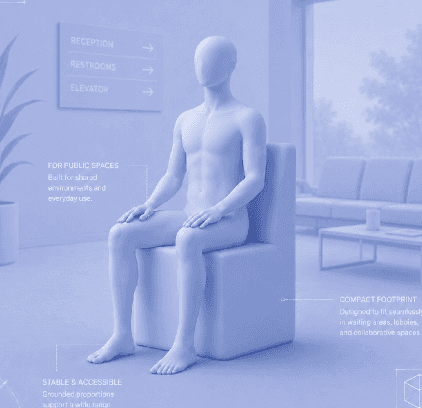
What does body data tell us about a chair?

A public waiting chair for Italian adults requires suitable evidence, an accommodation strategy and a traceable design decision.

01 / EVIDENCE

Choose the evidence

Population match and measurement coverage are separate choices.

Italian sample: 0 / 7 required measures. DINED 2004 proxy: 7 / 7. Record the population mismatch before calculating.

02 / ACCOMMODATION

Choose who it accommodates

Fixed, adjustable or multiple sizes?

Define the target and exclusions for a fixed chair; the range for adjustment; or the dimension relationships for size groups.

03 / DECISION

Translate and record

453 mm body reference → design decisions → fit check.

Allowance, final geometry and approval remain unestablished. The report image illustrates the intended output; its dimensions and approval stamps are not validated results.

A measurement becomes defensible when its source, assumptions and design decisions remain visible.

02

/RESEARCH

Evidence chain

The literature review identified human errors in interpreting body data and risks of AI overconfidence. These informed safeguards that expose assumptions, evidence limits and uncertainty ; so the system can help designers question a recommendation, rather than reinforce it in an echo chamber or offer false assurance.

02

/RESEARCH

Evidence chain

The literature review identified human errors in interpreting body data and risks of AI overconfidence. These informed safeguards that expose assumptions, evidence limits and uncertainty ; so the system can help designers question a recommendation, rather than reinforce it in an echo chamber or offer false assurance.

01 / PAPERS →

103 retained sources

Collage of anthropometry, design and AI literature reviewed for DINED Workspace

53 anthropometry + design
50 AI + HCI

AI-ASSISTED REVIEW

RAG supported the literature review and linked evidence tree.

02 / INSIGHTS →

Four research lenses

Data–user fit

Is this the right data for these users?

Data–product fit

Can this data support the product decision?

Reasoning–workflow fit

Can we still see how the decision was made?

AI guidance

How should AI guide and support the designer?

03 / CHALLENGES →

Where translation breaks

SELECT A CHALLENGE
04 / REQUIREMENTS

What the system must support

DR1 / Clarify context
DR2 / Expose evidence conditions
DR3 / Express accommodation
DR4 / Relate dimensions
DR5 / Match evidence to goal
DR6 / Trace transformations
DR7 / Preserve validation limits
DR8 / Keep decisions inspectable
TC-01 → DR1 + DR2

Population mismatch. A correct calculation may still represent the wrong users.

SOURCE / Thesis Table 4.2 and DR1–DR8. Presentation evidence-chain overview. Labels shortened for the website; links preserve the thesis crosswalk. This is research synthesis, not a measured effectiveness result.
/RESEARCH IN PRACTICE

Deep dive into challenges and requirements

1Public waiting chair / Italian adults / indoor waiting area.
2Italian sample: 0 of 7 chair measures; DINED 2004 proxy: 7 of 7.
3Age, sitting duration, clothing, adjustability and accommodation remain questions.
/CHALLENGES
Population mismatch — the data may represent different users.
Old data — collection date matters for present-day fit.
Missing conditions — measurement protocols and use context matter.
/DESIGN REQUIREMENTS
DR1 / Clarify users, task and consequential gaps.
DR2 / Keep population, date, protocol and proxy status visible.
Before calculating, establish who and what the evidence represents.
100%

/DESIGN BRIEF

Ask, Calculate, Warn, Explain, Record - under designer control.

Ask, Calculate, Warn, Explain, Record - under designer control.

Ask, Calculate, Warn, Explain, Record - under designer control.

An AI-orchestrated DINED workspace supporting design students and early-stage designers in understandable, traceable and defensible body-to-product decisions.

Ask

Clarify consequential gaps.

Calculate

Use defined numerical tools.

Warn

Expose mismatches and limits.

Explain

Connect evidence to decisions.

Record

Preserve assumptions and reasoning.

The designer confirms assumptions, chooses the direction and approves.

03

/Inside the project

Decisions and iterations

Field probes shifted the work toward the way designers frame problems.

03

/Inside the project

Decisions and iterations

Field probes shifted the work toward the way designers frame problems.

/PROTOTYPE ROUNDS

Build, test, learn, consolidate

Can anthropometric retrieval and calculation be made reliable and inspectable?
01 / Design request
02 / Measurement discovery
03 / Dataset lookup
04 / Defined tool calculation
05 / Inspectable output
1Source-derived reconstruction of the first prototype, not a new run.
2Outputs retained values, visuals, source information and warnings.
/WHAT WAS BUILT OR LEARNED
Design request → measurement discovery → dataset lookup → tool calculation.
Local numerical tool set developed from 15 to 19 tools.
/WHAT CHANGED NEXT
Inspectability established the foundation.
Next: investigate how AI coordinates the reasoning around tool execution.
Make the calculation inspectable before expanding the orchestration.
100%

04

/Inside the project

Keep the project and its reasoning together

Retained prototype behaviors became a persistent workspace connecting context, evidence and design artefacts. Screens use controlled example data.

04

/Inside the project

Keep the project and its reasoning together

Retained prototype behaviors became a persistent workspace connecting context, evidence and design artefacts. Screens use controlled example data.

AI proposes

Clarifies, retrieves evidence and calculates with defined tools.

Designer inspects and edits

Checks assumptions, evidence limits and the design direction.

Designer approves

Approval and physical validation remain explicit boundaries.

/FINAL WORKSPACE

The project remains connected

1Starting workspace; not a completed design decision.
/DESIGNER ACTION
Define users, product intent and use context.
/WHAT STAYS CONNECTED
Keep the brief and unresolved questions available throughout the project.
Start with a shared brief.
100%

/TECHNICAL IMPLEMENTATION

Next.js / CopilotKit / AG-UI · FastAPI / PydanticAI · Defined numerical tools · Typed artefacts and project memory

The thesis reports 120 API, 5 contract and 29 web tests for fixture-mode integration. These are reported technical checks, not new portfolio tests or evidence of a live deployment.

05

/Inside the project

Did the support help—and where did it fall short?

Separate formative interviews, task-based evaluation and expert critique informed the design direction. Preferences do not establish physical fit or long-term decision quality.

05

/Inside the project

Did the support help—and where did it fall short?

Separate formative interviews, task-based evaluation and expert critique informed the design direction. Preferences do not establish physical fit or long-term decision quality.

THESIS REPORTED

9

Formative interviews

Inputs to the interaction direction

BOUNDED STUDY

8

Student / designer sessions

Two-brief study and workspace review

THESIS REPORTED

4

Expert sessions

Critique of translation, warnings and workflow

THESIS REPORTED

9

Formative interviews

Inputs to the interaction direction

BOUNDED STUDY

8

Student / designer sessions

Two-brief study and workspace review

THESIS REPORTED

4

Expert sessions

Critique of translation, warnings and workflow

THESIS REPORTED

9

Formative interviews

Inputs to the interaction direction

BOUNDED STUDY

8

Student / designer sessions

Two-brief study and workspace review

THESIS REPORTED

4

Expert sessions

Critique of translation, warnings and workflow

AI support was preferred; confidence was more divided.

AI supportManual
Reported preference / projected N=8
02468
Starting the task
Manual 0
Useful information faster
Manual 0
Understanding
Manual 0
Confidence / trust

01 / PREFERENCE

AI support was preferred in the task.

Brief A preferences favored AI support. The chart retains the thesis aggregates projected to N=8; these are bounded task preferences.

02 / CONFIDENCE

A useful answer still needs inspection.

Six coded responses asked for less density. Structure, visuals and report-style explanations helped; fluent AI output could still create false confidence.

03 / NEXT ITERATION

Make the next action clear.

Brief B and expert critique called for task-appropriate explanations: identify who a warning affects, what a measurement supports and what the designer should do next.

06

/Inside the project

Outcome and next

“A model for using AI without losing the reasoning behind an anthropometric decision.”

06

/Inside the project

Outcome and next

“A model for using AI without losing the reasoning behind an anthropometric decision.”

/RESEARCH ANSWER

AI HELPS WHEN IT KEEPS THE DESIGNER’S REASONING INTACT.

AI HELPS WHEN IT KEEPS THE DESIGNER’S REASONING INTACT.

“ai can only guide, the designer needs to make the decisions”

“ai can only guide, the designer needs to make the decisions”

/THESIS CONTRIBUTIONS — FOUR CORE PILLARS

01 / FRAME THE PROBLEM

Translation Gap

Defining the translation gap from anthropometric values to design decisions.

02 / EVIDENCE CHAIN

Sources To Design Req.

Insights · Challenges · Requirements · Prototypes · Validation.

03 / DEFINE RESPONSIBILITIES

Design Brief

Design requirements and 5 support behaviours dividing AI calculation and designer judgment.

04 / EMBED IN A PRODUCT

DINED Workspace

Project memory, evidence basis, sizing artefacts, and inspectable report context.

04 / EMBED IN A PRODUCT

DINED Workspace

Project memory, evidence basis, sizing artefacts, and inspectable report context.

UNDERSTANDABLE · TRACEABLE · DEFENSIBLE

UNDERSTANDABLE · TRACEABLE · DEFENSIBLE

/LIMITATIONS AND FUTURE WORK

“The thesis establishes the direction.”

[ ■ LIMITATIONS ]

01 / CONTROLLED INTEGRATION

Complete workflow needs to be tested and refined with live data. Final integration used controlled fixture data.

02 / SHORT AND BOUNDED STUDIES

Supports directional validity; does not yet support wider educational, clinical or industrial adoption.

03 / INTERFACE TO BE OPTIMISED

Interface design was not an integral part of the thesis; focus was the inspectable reasoning model.

[ ■ NEXT STEPS ]

01 / PRODUCTION READY PRO

Hardened, production-ready tool testing complete end-to-end workflows with live anthropometric datasets.

02 / TEST WITH REAL DESIGN PROJECTS

Longer longitudinal studies deployed in design education and professional industrial design practice.

03 / INTERFACE AND INTERACTION STUDIES

Optimize the interface and recommendation ergonomics based on user preferences and task walkthroughs.